Before the casino: springs and a Kurpark
Homburg became a spa town because of its mineral springs. According to the city’s Kurpark leaflet, children rediscovered the Ludwigsbrunnen in 1809, the first healing spring to be found again. The Elisabethenbrunnen was rediscovered in 1834, and a positive assessment by the chemist Justus von Liebig helped establish Homburg as a spa. The Brunnenallee, the spring promenade, was laid out in 1834 and 1835.
The building that would house the casino’s first rooms followed soon after. The leaflet dates the Brunnensälchen to 1838 and 1839. According to Wikipedia, plans from 1830 to found a joint-stock company to build a Kurpark and a Kurhaus already included a casino, and in 1838 Homburg’s ruler met the twin brothers François and Louis Blanc, who ran a casino in Luxembourg.
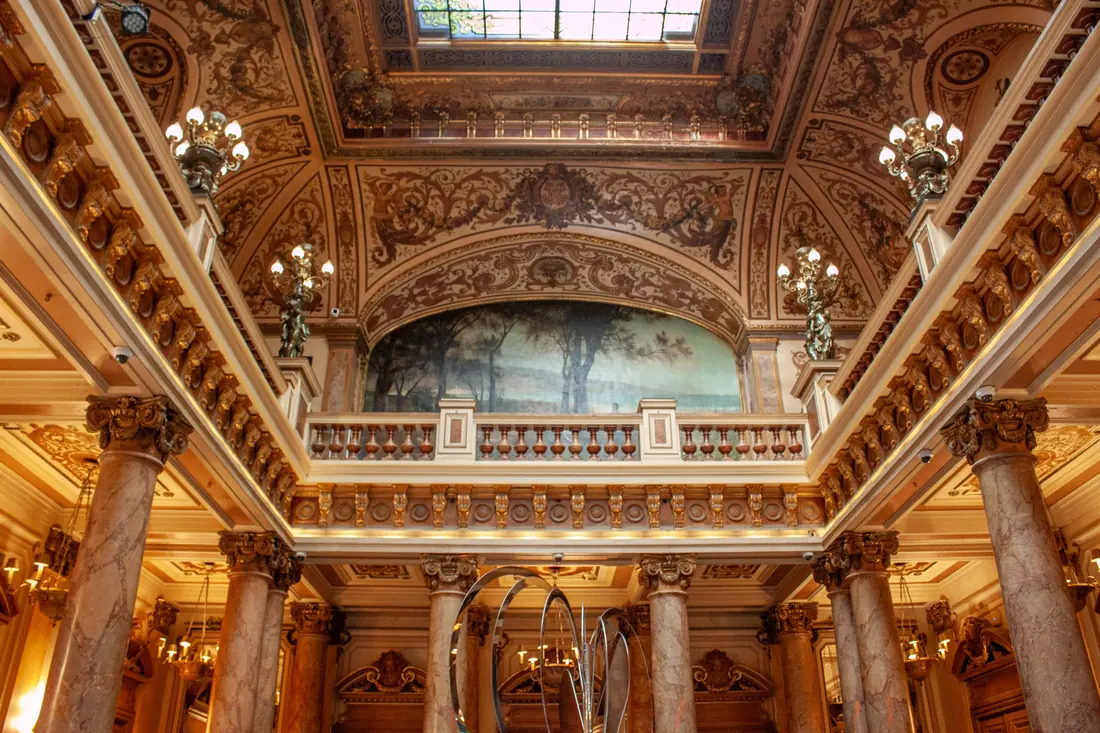
Chronicle 1840–2016
The entries below follow the chronicle published on the casino’s own website, supplemented where marked with Wikipedia and the city’s leaflets. Each entry names its source.
The Blanc years · 1840–1872
A concession for the Blanc brothers
The Blanc brothers obtain a 30-year concession for gambling from the Landgrave. In return they are to pay rent and build a Kurhaus.
Casino chronicleOpening in the Brunnensälchen
On 23 May the casino opens in the Brunnensälchen, where it stays until the Kurhaus is ready. The foundation stone of the Kurhaus is laid on the same day.
Casino chronicleMove into the Kurhaus
The casino moves into the Kurhaus. The city’s leaflet also gives 1843 as the year the first Kurhaus was completed.
Casino chronicle · City leafletA ban, and a closed club
The National Assembly in Frankfurt bans “places of immorality and idleness”. The casino turns into a closed club and is open to the public again after the Assembly breaks up.
Casino chronicleStreet lighting
The Blanc brothers finance a gasworks, and Bad Homburg gets regular street lighting.
Casino chronicleA railway to Frankfurt
Construction starts on a rail link between Frankfurt and Bad Homburg, financed by the Blancs.
Casino chronicleMonaco
François Blanc obtains a 50-year casino concession in Monaco and pays 1.7 million gold francs in cash.
Casino chronicleBad Homburg passes to Prussia
Landgrave Ferdinand dies without children on 24 March, and Bad Homburg falls to Prussia. Gambling is banned there, so the casino receives only a transition period.
Casino chronicle · WikipediaThe casino closes
Gambling stops. The ban was extended across the whole German Empire, and all casinos had to close by 31 December 1872.
Casino chronicle · WikipediaReopening and growth · 1949–1999
Play resumes
The Hermann Heidtmann KG offers gambling again in the Brunnensälchen, and the first new annex is built. Wikipedia gives 7 April 1949 as the reopening date.
Casino chronicle · WikipediaA restaurant of its own
A second annex is built, and the casino gets its own restaurant.
Casino chronicleThird annex
Heidtmann has a third annex built.
Casino chronicleFourth annex
The casino receives a fourth extension.
Casino chronicleSlot machines
Slot-machine gaming is introduced.
Casino chronicleBlack Jack
Black Jack is introduced.
Casino chronicleResults on a display
An automatic display of the most recent roulette results is introduced.
Casino chronicleResidents may play
The residency ban that kept Bad Homburg’s own citizens from the tables is lifted. Wikipedia gives 1 March 1986.
Casino chronicle · WikipediaAmerican Roulette
American Roulette is introduced.
Casino chroniclePoker
Poker is introduced.
Casino chronicleThe gaming rooms are redesigned
The gaming rooms are redesigned.
Casino chronicleA new operator · 2013–2016
Rebuilt while open
After an EU-wide tender, the concession goes to the François-Blanc-Spielbank GmbH, a subsidiary of the city-owned Kur- und Kongreß-GmbH. The casino is redesigned during operation, with building work between 04:00 and 12:00. Hesse premieres: a fully automatic roulette system with 23 seats linked to two tables, and Ultimate Texas Hold’em.
Casino chronicleSecond building phase
The smoking areas and the restaurant Le Blanc are redesigned.
Casino chronicleTwo German firsts
Bad Homburg becomes the first German casino to introduce Three Card Poker and Free Bet Black Jack. The restaurant terrace is renovated and Dostojewskis Bar is redesigned.
Casino chronicle175 years
The dance club Lounge is given a new direction, and the casino celebrates its 175th anniversary.
Casino chronicle
Sources differ on small points (for example, which Landgrave signed the 1840 concession), so this chronicle leaves such details out rather than guess.
Dostoevsky in Homburg
The Russian novelist Fyodor Dostoevsky gambled in Wiesbaden, Baden-Baden and, from October 1863, Bad Homburg, according to Wikipedia. His novel Der Spieler (The Gambler) names Homburg, although it is disputed which casino the fictional “Roulettenburg” is modelled on.
The city’s leaflet calls him a frequent guest and lists a sculpture of Dostoevsky by Nicolai Karlychanow, created in 2014, in the Kurpark. The casino’s bar carries his name: Dostojewskis Bar.
The “Mother of Monte Carlo”
The casino calls itself the “Mutter von Monte Carlo”. The basis is François Blanc’s step to Monaco: in 1863 he obtained a 50-year casino concession there and paid 1.7 million gold francs in cash, according to the casino’s chronicle. Wikipedia describes the nickname as a promotional self-description and says Blanc devoted himself fully to Monte Carlo after Bad Homburg closed.
Wikipedia also credits the Blanc brothers with dropping the double zero from roulette in Bad Homburg, which, it says, drew players from across Europe. The article adds that business was conducted mainly in French and that many staff came from the French-speaking town of Friedrichsdorf.